PR Health
CI pipelines exist to give developers fast, reliable feedback on their pull requests. When pipelines are slow or flaky, the impact lands squarely on the PR workflow, blocked merges, wasted reruns, and frustrated reviewers. CI/CD Watch tracks how CI affects your PRs so you can see where the bottlenecks are.
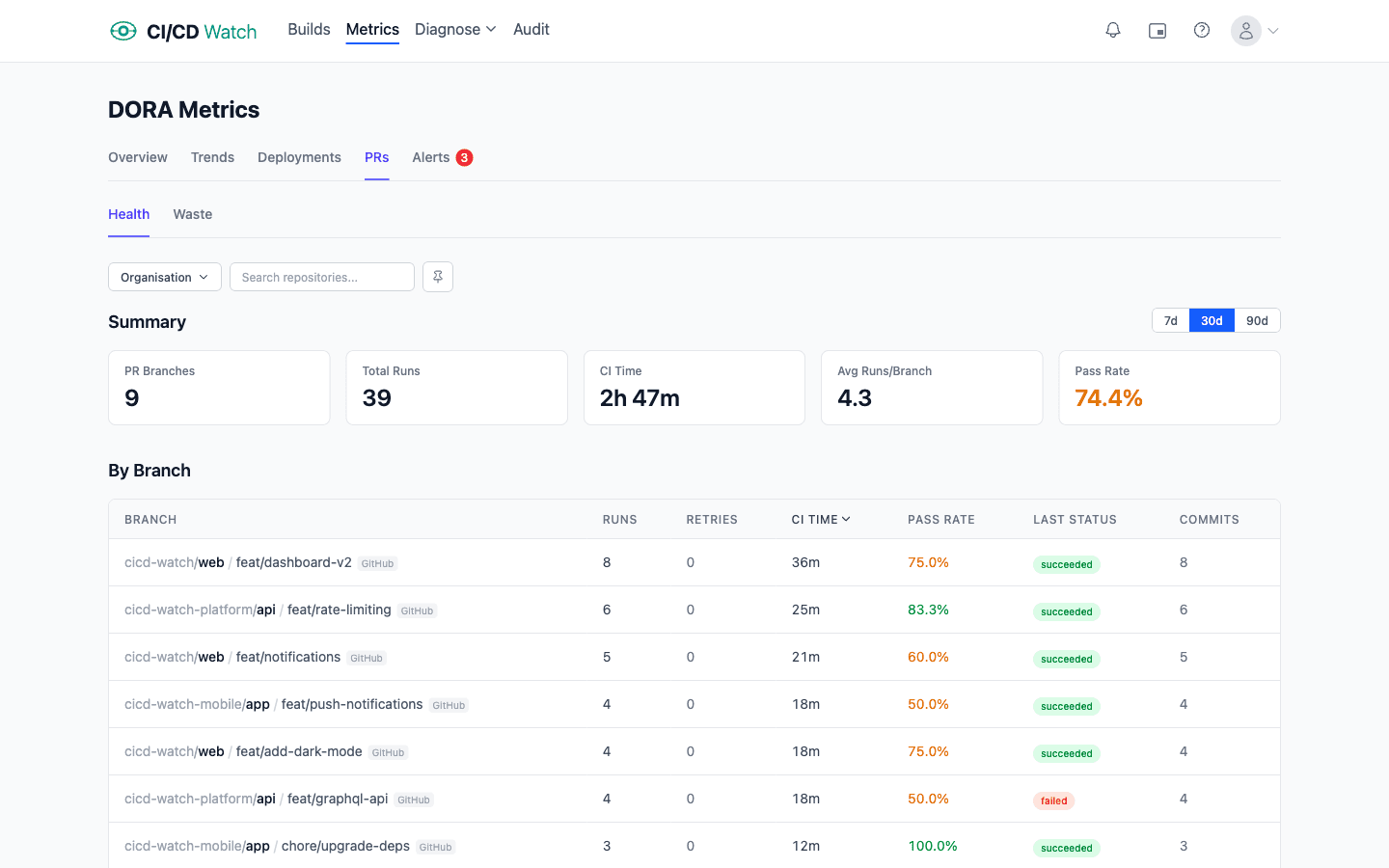
PR Health Dashboard
The Pull Requests page shows CI success rates across all your monitored repositories. For each repo, you can see how often PR-triggered pipelines pass on the first run, how often they fail, and the overall health trend over your selected time window.
Filter by provider, organization, or repository to focus on specific areas. Choose between 7, 30, or 90-day analysis windows to spot trends and regressions.
Waste Detection
The PR Waste sub-page surfaces the hidden cost of CI problems on your pull request workflow. It identifies developer wait time, the minutes engineers spend blocked while pipelines run, and wasted CI runs that produced no useful result.
Wasted runs include failures caused by flaky tests, cancelled pipelines, and duplicate triggers. Each is quantified in both time and estimated cost, making it easy to prioritize which pipelines to fix based on their impact on developer productivity.
Why It Matters
PR throughput is one of the most visible indicators of engineering velocity. When CI is reliable, PRs merge quickly and developers stay in flow. When CI is unreliable, PRs pile up, context-switching increases, and the team slows down.
By connecting CI performance to the PR workflow, CI/CD Watch helps you see the downstream effect of pipeline problems. A flaky pipeline might look like a minor annoyance in isolation, but when you see the total developer hours lost across all PRs in a month, the case for fixing it becomes clear.
Related
- Flaky Tests , identifying the tests that cause the most PR failures
- Pipeline Stability , how pipelines are classified as healthy, flaky, or broken
- Cost Calculations , quantifying the cost of CI waste on pull requests
- DORA Metrics , how PR cycle time relates to change lead time